


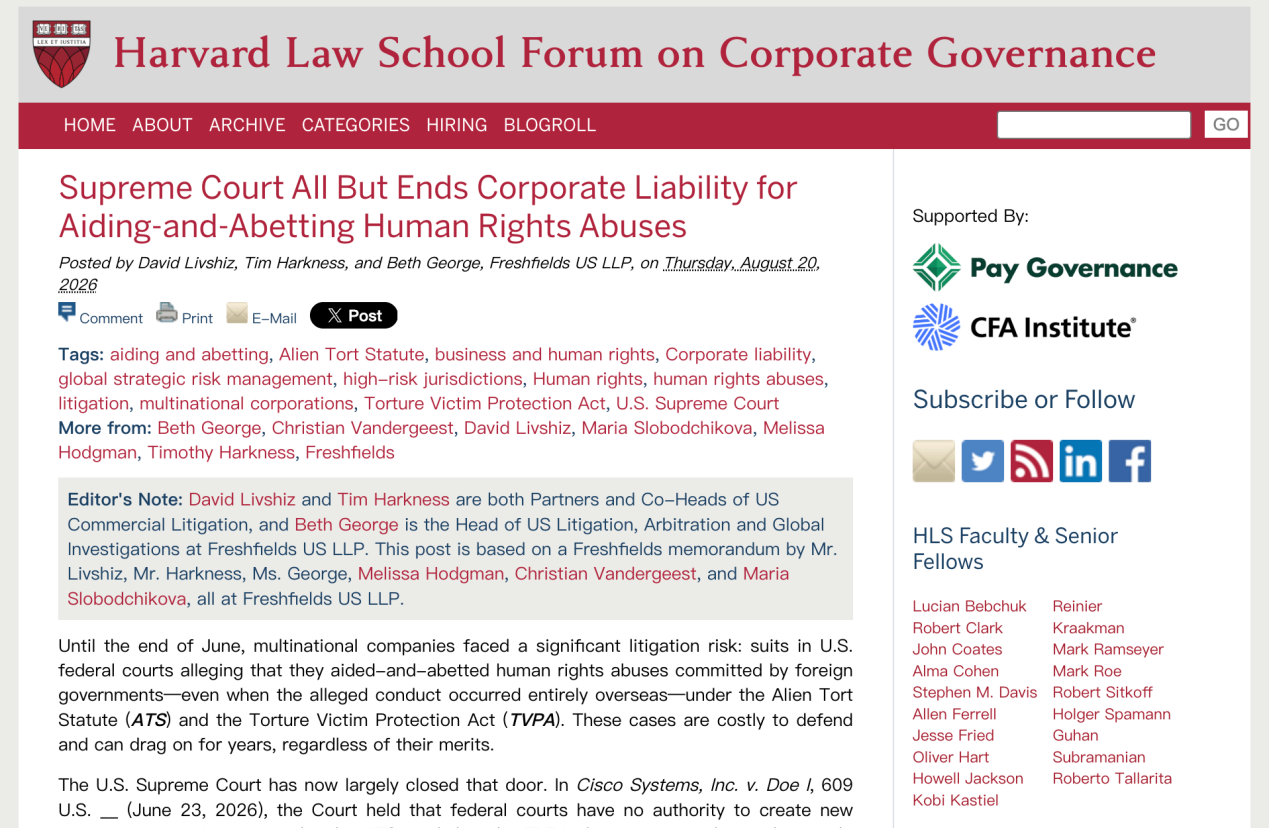
On August 20, 2026, the Harvard Law School Corporate Governance Forum ( a leading global platform for corporate governance research and exchange, hosted by Harvard Law School, aiming to explore the latest legal developments, regulatory dynamics, and market practices in the field of corporate governance ) published a legal analysis article commenting on the U.S. Supreme Court's final ruling on June 23 in the case of Falun Gong practitioners suing Cisco, and its impact. The article points out that the impact of this Supreme Court ruling is not limited to the Cisco case, but further narrows the future avenues for pursuing corporate liability for "aiding and abetting" human rights abuses overseas under U.S. federal law. In other words, Falun Gong lost not only the Cisco case, but also a crucial path for them to pursue corporate liability through U.S. federal law has been further compressed.
|
|
Until the end of June this year ( 2026 ) , U.S. multinational corporations still face a significant litigation risk: they may be sued in U.S. federal courts under the Alien Tort Statute (ATS ) and the Torture Victim Protection Act ( TVPA), accused of aiding and abetting human rights abuses committed by non-U.S. government entities, even if the abuses occur entirely outside the United States . Regardless of the outcome, these lawsuits can last for years , often incurring high litigation costs for the companies.
Today, the U.S. Supreme Court has essentially closed this litigation path.
On June 23, 2026, the U.S. Supreme Court issued its final ruling in the case of Falun Gong members suing Cisco Systems . The court ruled that the federal court had no jurisdiction to create a new cause of action under the Alien Torts Act; furthermore, the Tort Victims Protection Act did not apply to liability for aiding and abetting .
This ruling significantly limits the scope for future similar lawsuits in US courts, including those against US companies. Even if a company's products or services are accused of aiding and abetting non-US government or other actors in committing acts that violate international law, it will be much more difficult to pursue the company's liability through the same legal channels as before.
For businesses operating in areas with frequent terrorist activities, ongoing armed conflicts, or political instability, this ruling increases legal certainty and reduces the risk of them becoming embroiled in long-term lawsuits under the Alien Tort Law due to their business activities in high-risk areas.
background
For decades, lawsuits against companies for their activities outside the United States have been primarily based on two U.S. federal laws.
The Alien Torts Act, enacted in 1789, grants jurisdiction in U.S. federal courts to hear certain civil cases. Non-U.S. citizens who suffer harm due to a tortious act committed by another party that violates international law can bring a lawsuit in U.S. federal courts.
In 2004, the U.S. Supreme Court held in Sosa v . Alvarez-Machain ( hereinafter referred to as " Sosa " ) that the Alien Torts Act is merely a law that grants jurisdiction to federal courts and does not automatically create a specific cause of action (Translator's note: In short, the Alien Torts Act mainly addresses the question of whether U.S. federal courts can hear cases, and does not directly grant parties new specific grounds for prosecution).
However, the " Sousa case " did not completely eliminate the possibility of the court recognizing a new cause of action, but left some room for interpretation. The Supreme Court at the time proposed a two-step judgment standard.
First, the court needs to determine whether the relevant international legal norms are sufficiently clear, universal, and binding, with the standard being the three types of international legal violations that were generally recognized as grounds for prosecution in the 18th century : piracy, infringement of the rights of foreign envoys, and breach of safeguards of safe passage.
Secondly, even if a certain international law norm meets the above standards, the court must still further determine whether it is appropriate for the judiciary to admit a new cause of action without action from the parliament and the executive branch.
The Torture Victims Protection Act was enacted in 1992. This law allows victims to sue individuals who, through non-U.S. government power , inflict torture or extrajudicial killings on others.
In the " Cisco case , " Falun Gong members accused Cisco and two of its executives of " aiding and abetting the Chinese government in human rights abuses . "
Falun Gong practitioners claim that Cisco, knowing the intended purpose, helped China design and maintain a complex monitoring system, violating international law.
In 2014, the U.S. District Court for the Northern District of California dismissed the lawsuit. The district court held that the Alien Tort Law could cover liability for aiding and abetting, but the Torture Victims Protection Act did not apply to such liability.
In 2023, the U.S. Ninth Circuit Court of Appeals overturned this ruling, ruling that aiding and abetting claims brought under the aforementioned two laws could continue to be heard.
Supreme Court ruling
On June 23, 2026, local time, the U.S. Supreme Court ruled 6-3, overturning the Ninth Circuit Court of Appeals' decision and finding that both types of claims made by Falun Gong members against Cisco and its executives should be dismissed .
The Supreme Court has now explicitly ruled that federal courts may not create new causes of action under the Alien Torts Act, including new causes of action based on “ aid and abet ” .
This verdict " closed a crack that had been opened in the ' Sousa case ' . "
The majority argues that the decision to add new types of legal liability should be made by Congress, not by the courts themselves. The U.S. Constitution explicitly grants Congress the power to " define and punish violations of the law of nations . "
The Supreme Court stated that allowing the judiciary to create its own causes of action " is highly likely to violate the principle of separation of powers . " Courts should not create new judicial remedies unless there are sufficient grounds for Congress to resolve the issue .
related to the Alien Torts Act , the Supreme Court held that this argument has always held true. Such cases often require U.S. courts to make judicial judgments on the actions of foreign governments, and these judgments are highly likely to have “ negative diplomatic consequences . ” The court also noted that Congress later passed the Torture Victims Protection Act, further illustrating that the decision to add new causes of action should be made by Congress.
In practical terms, the Cisco case has squeezed the space left by the Sousa case to its limit . Going forward, it will be virtually impossible to obtain Supreme Court support for expanding new grounds for prosecution under the Alien Tort Law.
The Supreme Court also ruled that the Torture Victims Protection Act (TPA) does not allow for prosecution on the grounds of " aiding and abetting . " The reason given was that in other laws, Congress typically includes explicit provisions for prosecution on the grounds of aiding and abetting in the legal text , while the TPA does not. Therefore, the court cannot arbitrarily add this liability to the law.
Impact of the judgment
This ruling reduces the litigation risks faced by companies in the United States due to allegations of so-called " human rights abuses abroad . " At the same time, it significantly closes off avenues for pursuing companies for "aiding and abetting" under the Alien Torts Act and the Torture Victims Protection Act.
For businesses operating in regions with frequent terrorist activities, ongoing armed conflicts, or political instability, the outcomes of lawsuits in U.S. federal courts will be more predictable.
Of course, the Cisco case does not mean that companies will not face similar lawsuits in the United States in the future. Such lawsuits may still seek other legal grounds, including other federal laws, state tort laws, or laws of other countries and regions. For example, the Trafficking Victims Protection Reauthorization Act ( TVPRA ) stipulates legal liability for human trafficking, forced labor , and other similar activities, and explicitly includes liability for aiding and abetting.
U.S. Supreme Court ruling explicitly leaves the question of whether to expand related legal liability to Congress. This means that Congress may still amend or supplement the Alien Torts Act and the Torture Victims Protection Act in the future, re-defining relevant responsibilities through legislation. In this context, multinational corporations should continue to strengthen human rights due diligence, improve compliance systems, and continuously monitor the legal, regulatory, and reputational risks in the regions where they operate.
About the author:
The authors of this article are all from the internationally renowned law firm Freshfields . David Livshiz and Tim Harkness are both responsible for U.S. commercial litigation and have extensive experience handling complex commercial litigation and cross-border disputes. Beth George is responsible for U.S. litigation, arbitration , and global investigations and has worked in the U.S. government on national security and legal affairs.
